


CSA hosts European Maritime Security Conference in Croatia
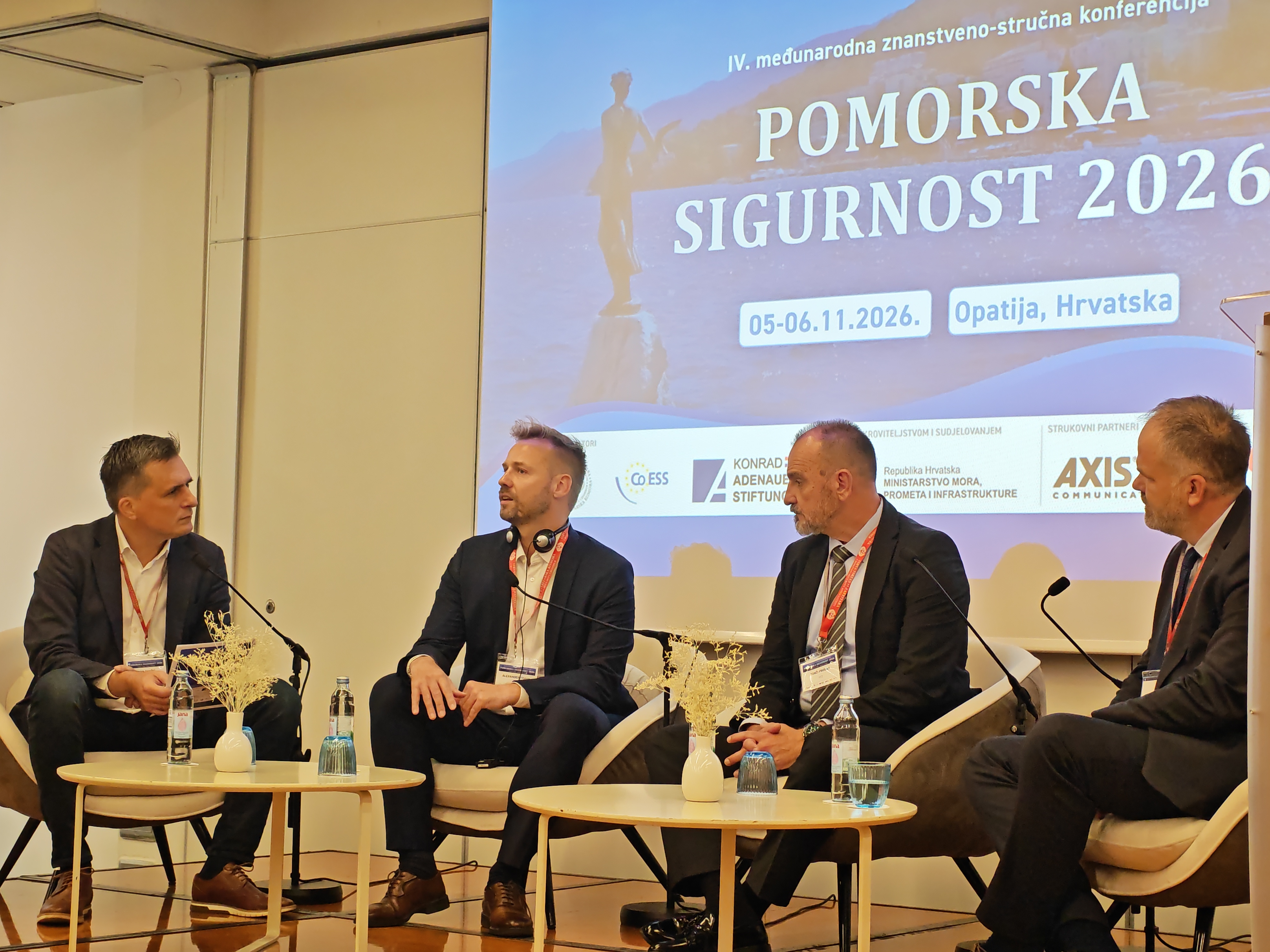
The 4th international scientific and professional conference "MARITIME SECURITY 2026" was held on 5-6 November in Opatija, organized by the Croatian Security Association, under the auspices of the Ministry of the Sea, Transport and Infrastructure of the Republic of Croatia, and co-organized by the Konrad Adenauer Foundation and the Confederation of European Security Services (CoESS). The professional partners of the conference were Securitas Croatia, Axis Communications and Alarm automatika.
After three successfully held editions in Split, this years conference was held in Opatija, gathering representatives of state institutions, port authorities and captaincy, maritime and security industry, private protection, academic community and experts in physical and cyber security.
This years conference focused on the protection and security of ports as part of critical infrastructure, with a special emphasis on new and complex forms of threats, strategic resilience, cybersecurity, hybrid operations, and the application of modern security technologies.
Modern seaports are extremely complex systems in which maritime traffic, international trade, energy infrastructure, information and communication systems, and numerous economic and operational entities are intertwined. Threating any of these elements can have consequences that go beyond the boundaries of the port itself, affecting human safety, the continuity of maritime traffic, supply chains, and economic stability. That is why the central message of the conference was that port security is not the responsibility of just one entity, but a shared system that requires connecting people, information, coordination, procedures and technology.
In the introductory part of the conference, the participants were addressed by Lidija Stolica, President of the Croatian Security Association, Dr. Norbert Eschborn, Director of the Konrad Adenauer Foundation Office for Croatia and Slovenia, Alexander Frank, Deputy Director General of CoESS, and Captain Darko Glazar from the Ministry of the Sea, Transport and Infrastructure of the Republic of Croatia.
In his opening remarks, he highlighted the importance of international and cross-sectoral cooperation, the exchange of expert knowledge and experience, and the development of effective models for the protection of seaports and critical infrastructure. The need to connect institutions, port operators, private security, the security industry and the academic community into a unified and coordinated security system was particularly emphasized.
First module – Maritime security and strengthening of strategic resilience
The first thematic module was dedicated to European security policies, the protection of strategic maritime infrastructure and new security challenges.
Alexander Frank from CoESS gave a presentation entitled Securing Europes Gateways: Harmonising Search and Security Procedures Across EU Ports, which addressed the importance of harmonizing security procedures and strengthening the protection of European maritime entry points.
Tonci Prodan from the Faculty of Forensic Sciences of the University of Split and the University of Defence and Security Dr. Franjo Tudman and a member of the CoESS Maritime Security Committee presented the topic Strategic Resilience of Submarine Critical Infrastructure, highlighting the importance of protecting submarine infrastructure systems and their role in preserving the security and stability of modern society.
Matija Mandic, CEO of SmartX Fusion Technologies, held a presentation entitled Cyber Challenges in the Age of Artificial Intelligence, which focused on new technological challenges and security risks associated with the development of artificial intelligence and the increasing digitalization of critical systems.
The module concluded with a panel discussion featuring Alexander Frank, Tonci Prodan and Matija Mandic, moderated by Ivan Funcic, Vice President of the Croatian Security Guild. The discussion focused on the strategic resilience of European maritime infrastructure, the protection of undersea systems and the need to connect physical and cyber security.
Second module – Integrated solutions in the protection of critical facilities
The second module was dedicated to presenting modern technical and technological solutions for improving the safety of maritime facilities and infrastructure.
Vedran Mihaljevic from Alarm automatika presented the topic Safety solutions for ships up to 300 BT, with an emphasis on technical solutions and safety requirements in the field of vessel protection.
Matej Sajdl from the company KAM-SEE, Axis Communications, presented the topic Axis camera and radar fusion in marine surveillance, showing the possibilities of integrating different technologies to improve the surveillance and safety of marinas.
The solutions presented highlighted the increasingly important role of technological integration, intelligent video surveillance, radar systems and advanced surveillance capabilities in creating effective and adaptable security systems for maritime areas.
Module Three – Critical Infrastructure, Security Incidents and Crisis Response
The third module was dedicated to the legislative and implementation framework for the protection of critical infrastructure and the organization of security response in crisis situations.
Drazen Stajduhar, Head of the Disaster Risk Reduction Sector of the Civil Protection Directorate of the Ministry of the Interior of the Republic of Croatia, gave a presentation on the Critical Infrastructure Act - Implementation Framework, presenting the normative and organizational prerequisites for the implementation of the critical infrastructure protection system.
Boris Mijolovic, Regional Manager at Securitas Croatia, presented the topic Port Security and Crisis Response, with an emphasis on security challenges in the port environment and the importance of preparedness, coordination and timely action in the event of security incidents.
The module concluded with a panel discussion featuring Drazen Stajduhar from the Civil Protection Directorate of the Ministry of the Interior of the Republic of Croatia, Boris Mijolovic from Securitas Croatia, and Andreja Ana Lopac from LNG Croatia, moderated by Tonci Prodan from the University of Split and the Croatian Security Guards Guild.
The discussion focused on the implementation of the critical infrastructure protection system, cooperation between competent institutions and operators, and the importance of effective coordination and response to crisis situations. The need for clear definition of responsibilities, exchange of information, and linking of operational capacities of all stakeholders involved was particularly emphasized.
The conference confirmed the importance of private security as an integral part of the integrated security system of seaports. The private security sector, with its professional and operational capacities, participates in the daily protection of areas, access control, surveillance, protection of people and property, and early recognition of potential security threats.
Likewise, the importance of private security cooperation with port authorities, port operators, harbormasters, police, customs, fire and emergency services, and information and cybersecurity experts was emphasized.
The final message of the conference was that modern seaport security cannot be based solely on individual security measures and technologies. It is necessary to develop an integrated protection model that connects people, knowledge, information, procedures, technology and the responsibility of all participants.
By organizing this conference, the Croatian Security Guild continues its active role in the development of the security profession and promoting cooperation between the public and private sectors, international professional organizations, and the academic community.
The goal of the conference is not only the exchange of expert information and the presentation of new technologies, but also the encouragement of specific partnerships, the improvement of professional and operational capacities and the development of a more resilient system of maritime infrastructure protection.
The 4th International Scientific and Professional Conference Maritime Security 2026 once again confirmed that knowledge, expertise, responsibility and coordinated action of all stakeholders are key prerequisites for the safety and resilience of seaports as one of the most important parts of critical infrastructure.